Understanding Collective Rights Management Organizations: Insights from Rosé’s KOMCA Withdrawal
“APT.,” the single collaboration between BLACKPINK member Rosé and American singer Bruno Mars, has become a global sensation, reaching number one on YouTube’s most popular music videos worldwide, almost to the point of being an earworm. Interestingly, after its release on October 24, 2024, Rosé also notified the Korea Music Copyright Association (KOMCA) on October 31 of the same year of her withdrawal from the association. It’s rare to see news about copyright collective management organizations in the media, so this provides an opportunity to introduce this complex yet necessary collective management (licensing) mechanism in the copyright field. Friends can first read the following report:

ROSÉ正式退出「韓國音樂著作權協會」!未來將由大西洋唱片公司分潤,避產生雙重版權費
2025-02-20 13:30 Arollin
According to Korean media Dispatch’s 2/20 report, BLACKPINK member Rosé has officially withdrawn from the Korea Music Copyright Association (KOMCA). On October 31 last year, Rosé had already applied to the organization to terminate the trust. After approximately a three-month grace period, the contract ultimately ended last month (January 31). In the future, all of Rosé’s copyrights will be managed and profits distributed by the American publisher (Atlantic Records). Additionally, Rosé is the first Korean singer to proactively leave the organization since Seo Taiji.
Let’s first look at the news headline: “Avoiding Dual Copyright Fees” should be an incorrect description. For copyright users, regardless of whether Rosé joins different copyright collective management organizations in different countries, copyright users will not pay so-called double royalties because of this. What might actually have “double charges” are different copyright collective management organizations—different collective management organizations will separately charge rights holders “management fees.”
It’s understood that Rosé signed an exclusive management contract with Atlantic Records under Warner Music Group in September 2024, including that all musical works created by Rosé will be managed by Atlantic Records. As a trustee or exclusive licensee, the company will handle royalty collection matters for copyright uses such as broadcasting, television, internet, or public performances through copyright collective management organizations it joins or cooperates with. Since music has no borders, mainstream copyright collective management organizations responsible for management may establish sister associations or commission management relationships with copyright collective management organizations in other countries by joining international organizations or concluding individual agreements. Sister associations in each country manage the use of member music in local countries on their behalf, thus enabling copyright owners to receive royalties for copyright use in various countries.
For example, when a Korean pop singer holds a concert in Taiwan, the concert organizer doesn’t obtain public performance authorization from Korean music copyright collective management organizations but may obtain concert public performance authorization from MÜST (Copyright Association of R.O.C.). This is because MÜST has joined CISAC (International Confederation of Societies of Authors and Composers), and like the aforementioned KOMCA that Rosé originally joined, which has also joined CISAC, MÜST and KOMCA, through reciprocal arrangements, have MÜST collect royalties for public performances and other uses of KOMCA member musical works in Taiwan, then settle accounts with KOMCA. Therefore, copyright owners basically don’t need to separately join different collective management organizations in different countries and can still enjoy mechanisms equivalent to cross-border management.
Of course, conversely, joining different collective management organizations—because collective management organizations charge management fees ranging up to 20% of collected royalties to maintain operations—may be somewhat disadvantageous for copyright owners. But personally, I think it’s still to avoid settlement issues. After all, when a copyright owner joins different copyright collective management organizations in different countries, which country’s copyright collective management organization should settle related royalties may also cause confusion. So rather than saying Rosé is very shrewd, it’s better to say this is normal handling in the copyright collective management organization field. After all, after Rosé signed an exclusive management contract with Atlantic Records, her focus won’t just remain in Korea.
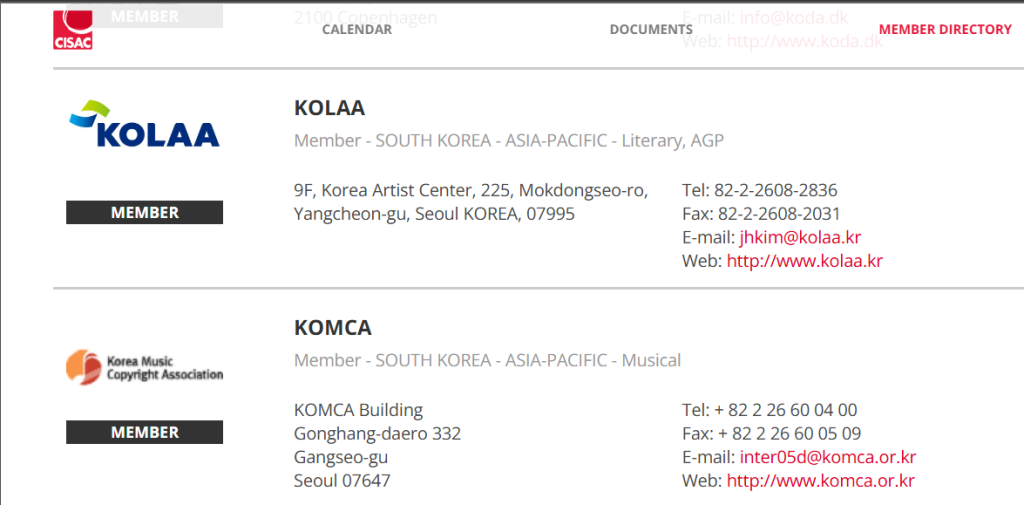
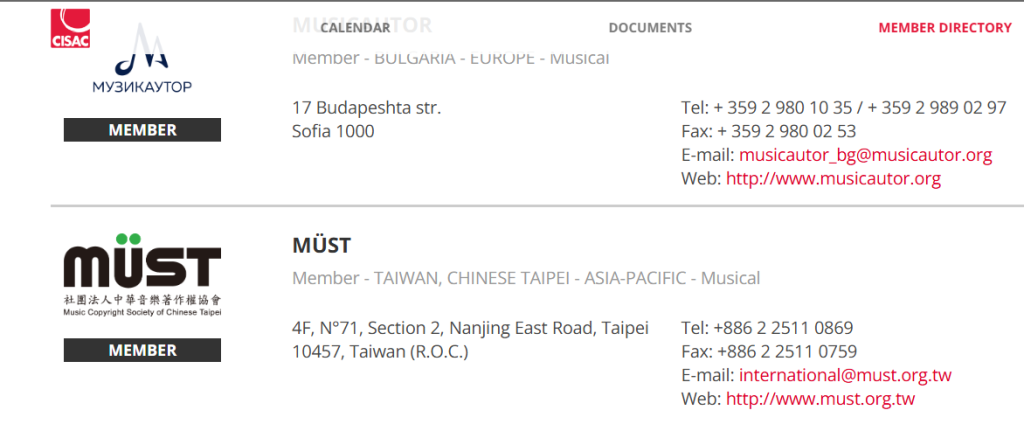
From the CISAC website member list, you can see that Korea actually has more than one copyright collective management organization that has joined, while Taiwan only has MÜST.
Copyright collective management organizations mainly handle large-volume, small-amount, frequent copyright use demands in society, such as radio stations, television stations, or video streaming platforms like Netflix and LineTV. Actually, every minute and second they may be using others’ music or other works. If they had to obtain authorization from copyright owners one by one, it would require enormous authorization processing costs and wouldn’t be profitable at all. In turn, it might result in “not using works.” This obviously isn’t possible. Copyright owners certainly don’t want to see their works being used without receiving appropriate compensation. This promotes the emergence of intermediary organizations like copyright collective management organizations. Copyright collective management organizations obtain commissions from many members, collecting numerous works together to collect royalties from copyright users. Originally, small-amount copyright uses worth one or two yuan per use now have legal authorization channels. Copyright users are also happy to obtain authorization for large-scale copyright uses from copyright collective management organizations at once. Therefore, copyright collective management organizations currently mainly manage: public broadcasting (radio stations, television stations, etc.), public transmission (internet), public performance (concert music performances or amusement park music broadcasts, etc.), and a small portion may include some reproduction rights. Therefore, cultural and creative industry practitioners will inevitably deal with copyright collective management organizations at some point in their careers. Taiwan also has a special law—the Copyright Collective Management Organization Act—to handle special regulations for copyright collective management organizations from establishment to operation.
I’ll introduce this far for now. When there’s time, I’ll continue introducing the complex legal and practical operational issues of Taiwan’s copyright collective management organizations.