
知識分享
Insights
Legal Risk Management
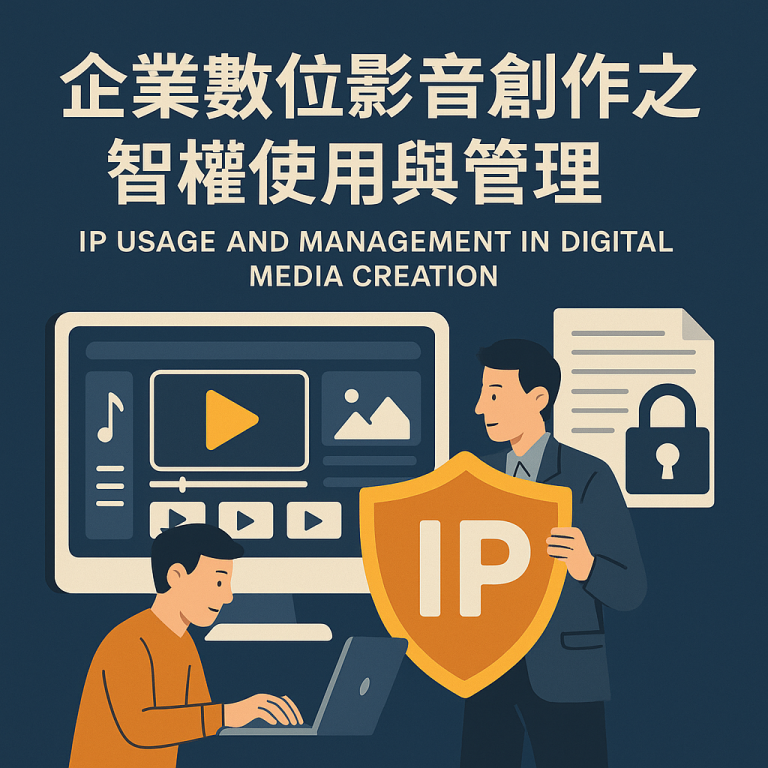
Intellectual Property Use and Management in Corporate Digital Audio-Visual Creation
◎ Lai, Wenchi "When TikTok sounds, parents raise their children in vain" - beyond mocking TikTok's influence on teenagers, we must also acknowledge the fact that audio-visual media spreads more easily than text. Many adults often lose track of time scrolling through short videos on their phones, and elderly people frequently share video files with each other via LINE. Whether actively or passively, enterprises need to enter the field of digital audio-visual creation in order to reach more users with their brands, products, or services. However, compared to text, audio-visual creation has not only higher creative barriers but also more complex copyright issues. The following provides a preliminary explanation of matters requiring attention in the use and management of corporate audio-visual creation. 1. Audio-Visual Creation Usually Involves Multiple Works From advertisements and short videos to TV series and films, all are "audiovisual works" protected by copyright law. However, the bigger problem is that to respond to today's rapidly changing market,⋯
Governance and Challenges of Intellectual Property Compliance in the Age of AI
Dear directors and executives, good afternoon. I am delighted to be invited by the Taiwan Directors Association to share legal issues related to AI with you at Chia Hsin Cement Corporation. Today's topic is "Governance and Challenges of Intellectual Property Compliance in the AI-Driven Era." With the rapid development of artificial intelligence (AI) technology, corporate boards are facing unprecedented governance challenges, and the role of boards is also transforming. We will explore this from four perspectives: First, what governance challenges AI technology development brings to boards and how board roles are changing. Second, the importance of intellectual property rights in the AI era and risk management. Third, how to leverage generative AI to enhance intellectual property governance effectiveness. Finally, the responsibilities and practical directions boards should undertake in the AI era across four dimensions: governance, transparency, digital, and innovation. I hope through these insights to help you prepare comprehensively in corporate compliance and governance. I. Governance Challenges and Board Role⋯
Understanding Corporate Data Governance – A Legal Perspective
Data Governance is a collection of activities (planning, monitoring, and executing) that exercise authority and control over data asset management. The data governance function guides how other data management functions should be executed. Under this definition, corporate data governance refers to an organization's management and control of data during its operations to ensure data quality, availability, security, and regulatory compliance. The purpose of corporate data governance is to enable companies to effectively manage their data resources, enhance decision-making processes, and improve business operational efficiency. From a legal perspective, it concerns how data from front-end collection to back-end utilization or sharing can serve the company while avoiding illegal data collection, processing, and utilization, as well as how to avoid misuse, misjudgment, leakage, or other regulatory compliance risks. "Data is the oil of the 21st century," but data and oil differ substantially in nature. First, oil is a finite natural resource that inevitably diminishes with extraction; data, however, becomes increasingly easier to⋯
Plant Variety Names and Trademarks: Insights from Zespri’s Brand Strategy
When one thinks of kiwifruit, does the name Zespri (the kiwifruit brand of Zespri Group Limited) immediately come to mind? Kiwifruit is native to Taiwan and China, and its official name is Chinese gooseberry. Surprisingly, it did not receive significant attention in its native regions. However, after being introduced to New Zealand, through breeding and selection, superior varieties were developed, and it ultimately became one of New Zealand's most iconic fruits. It was even marketed worldwide under the name of a bird native to New Zealand. Today, many people know it as "kiwifruit," but may not be aware that its original name was actually Chinese gooseberry! This demonstrates the tremendous value and influence that superior plant varieties can bring, which should not be underestimated. When discussing the protection of superior varieties, one must mention "Plant Variety Rights" (PVR). However, Plant Variety Rights operate under the principle of territoriality, meaning that such rights are only valid in the country or region⋯
A Brief Analysis of Taiwan’s PDPA Amendment: Towards Independent Oversight and the Challenges of AI Governance
I. Core Amendments and Background On March 27, 2025, the Executive Yuan announced the draft Organizational Act of the Personal Data Protection Commission and draft amendments to parts of the Personal Data Protection Act. This was stated as an effort to "establish a comprehensive independent supervisory mechanism with robust enforcement powers, and to institute data governance for the era of pervasive Artificial Intelligence (AI)." These proposed changes represent what could be the most substantial revisions to the PDPA since its initial enactment. This article aims to analyze the substance of these amendments, compare them against relevant international legal norms, examine the current trajectory of the revisions, and assess the extent to which the stated goal of "data governance for the era of pervasive AI application" is realized. The central objective of this amendment is to establish an independent supervisory framework for personal data protection, as mandated by a judgment of the Constitutional Court 2022. This primarily concerns the institutional structure and mandate of⋯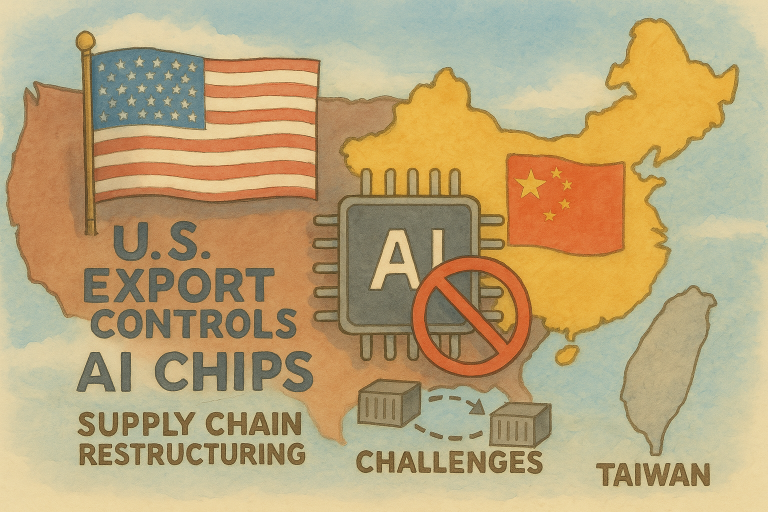
Legal Risks Under Supply Chain Restructuring – Understanding the Know Your Customer Guidance for U.S. Export Controls
I. To Prevent U.S. AI Chips from Being Exported to China, the U.S. Department of Commerce Will Enforce Strongly and Recommends Related Companies Implement Know Your Customer (KYC) Due Diligence Just as U.S. President Biden was about to leave office in early 2025, he proposed the latest AI chip export control plan—the "Interim Final Rule on Artificial Intelligence Diffusion." The public will have 120 days to submit comments, and the industry will have one year after the new law's implementation to adjust to meet new security standards. According to this latest AI chip export control rule, the U.S. divides AI chip exports into three tiers. The first tier of key allies and partners includes Australia, Belgium, Canada, Denmark, Finland, France, Germany, Ireland, Italy, Japan, the Netherlands, New Zealand, Norway, South Korea, Spain, Sweden, Taiwan, and the United Kingdom, who will not be subject to export controls. Countries listed by the U.S. as third-tier controls include approximately 22 countries such as⋯
Understanding Collective Rights Management Organizations: Insights from Rosé’s KOMCA Withdrawal
"APT.," the single collaboration between BLACKPINK member Rosé and American singer Bruno Mars, has become a global sensation, reaching number one on YouTube's most popular music videos worldwide, almost to the point of being an earworm. Interestingly, after its release on October 24, 2024, Rosé also notified the Korea Music Copyright Association (KOMCA) on October 31 of the same year of her withdrawal from the association. It's rare to see news about copyright collective management organizations in the media, so this provides an opportunity to introduce this complex yet necessary collective management (licensing) mechanism in the copyright field. Friends can first read the following report: ROSÉ正式退出「韓國音樂著作權協會」!未來將由大西洋唱片公司分潤,避產生雙重版權費2025-02-20 13:30 Arollin According to Korean media Dispatch's 2/20 report, BLACKPINK member Rosé has officially withdrawn from the Korea Music Copyright Association (KOMCA). On October 31 last year, Rosé had already applied to the organization to terminate the trust. After approximately a three-month grace period, the contract ultimately ended last month (January 31). In the⋯
Switching Jobs Before Lunar New Year—No Year-End Bonus?
This article is excerpted from Attorney Tsai Shu-Chuan's book "When Cultural and Creative Industries Meet Law: Human Resource Management" (New book released 2024/11/05) Every year-end, when media continuously reports that the financial industry, technology industry, shipping industry, and other highly profitable industries that year will distribute various high-value year-end bonuses, it always makes "How much year-end bonus will the company give this year?" the most concerning topic for office workers. For workers with job-switching plans, a more important issue is "Will I lose my year-end bonus if I switch jobs before the Lunar New Year?" When employers distribute year-end bonuses, can they refuse to pay bonuses on the grounds that employees are not employed at the time of distribution (have already resigned)? This depends on whether the nature of the year-end bonus constitutes wages. In short, if the year-end bonus belongs to wages, even if employees are no longer employed at the time of distribution, employers should still pay it.⋯
A Discussion on Corporate Data Governance Prompted by iRent’s Excessive Personal Data Collection and Usage Incident
On January 7, 2025, the Consumers' Foundation held a press conference pointing out that iRent (Hotai Motor Co., Ltd.'s car rental division) collected excessive personal data in its rental terms and required consumers to agree to share personal data with affiliated companies, potentially violating the Personal Data Protection Act. The competent authority for car rental services, the Directorate General of Highways, dispatched personnel from the Taipei City Motor Vehicles Office to conduct an administrative inspection. They determined that the reasonableness and necessity of these terms were not clear and required iRent to improve. Hotai Motor Company also shut down the joint marketing data system function within the group. This is actually an unreasonable expectation that many large enterprises in the past have had—hoping to collect data once and apply it to all "affiliated companies." Without an appropriate corporate data governance framework, common situations violating the Personal Data Protection Act emerge from service planning to data management architecture. Let's first look⋯Intellectual Property Use and Management in Corporate Digital Audio-Visual Creation
◎ Lai, Wenchi "When TikTok sounds, parents raise their children in vain" - beyond mocking TikTok's influence on teenagers, we must also acknowledge the fact that audio-visual media spreads more easily than text. Many adults often lose track of time scrolling through short videos on their phones, and elderly people frequently share video files with each other via LINE. Whether actively or passively, enterprises need to enter the field of digital audio-visual creation in order to reach more users with their brands, products, or services. However, compared to text, audio-visual creation has not only higher creative barriers but also more complex copyright issues. The following provides a preliminary explanation of matters requiring attention in the use and management of corporate audio-visual creation. 1. Audio-Visual Creation Usually Involves Multiple Works From advertisements and short videos to TV series and films, all are "audiovisual works" protected by copyright law. However, the bigger problem is that to respond to today's rapidly changing market,⋯Governance and Challenges of Intellectual Property Compliance in the Age of AI
Dear directors and executives, good afternoon. I am delighted to be invited by the Taiwan Directors Association to share legal issues related to AI with you at Chia Hsin Cement Corporation. Today's topic is "Governance and Challenges of Intellectual Property Compliance in the AI-Driven Era." With the rapid development of artificial intelligence (AI) technology, corporate boards are facing unprecedented governance challenges, and the role of boards is also transforming. We will explore this from four perspectives: First, what governance challenges AI technology development brings to boards and how board roles are changing. Second, the importance of intellectual property rights in the AI era and risk management. Third, how to leverage generative AI to enhance intellectual property governance effectiveness. Finally, the responsibilities and practical directions boards should undertake in the AI era across four dimensions: governance, transparency, digital, and innovation. I hope through these insights to help you prepare comprehensively in corporate compliance and governance. I. Governance Challenges and Board Role⋯Understanding Corporate Data Governance – A Legal Perspective
Data Governance is a collection of activities (planning, monitoring, and executing) that exercise authority and control over data asset management. The data governance function guides how other data management functions should be executed. Under this definition, corporate data governance refers to an organization's management and control of data during its operations to ensure data quality, availability, security, and regulatory compliance. The purpose of corporate data governance is to enable companies to effectively manage their data resources, enhance decision-making processes, and improve business operational efficiency. From a legal perspective, it concerns how data from front-end collection to back-end utilization or sharing can serve the company while avoiding illegal data collection, processing, and utilization, as well as how to avoid misuse, misjudgment, leakage, or other regulatory compliance risks. "Data is the oil of the 21st century," but data and oil differ substantially in nature. First, oil is a finite natural resource that inevitably diminishes with extraction; data, however, becomes increasingly easier to⋯