Plant Variety Names and Trademarks: Insights from Zespri’s Brand Strategy
When one thinks of kiwifruit, does the name Zespri (the kiwifruit brand of Zespri Group Limited) immediately come to mind? Kiwifruit is native to Taiwan and China, and its official name is Chinese gooseberry. Surprisingly, it did not receive significant attention in its native regions. However, after being introduced to New Zealand, through breeding and selection, superior varieties were developed, and it ultimately became one of New Zealand’s most iconic fruits. It was even marketed worldwide under the name of a bird native to New Zealand. Today, many people know it as “kiwifruit,” but may not be aware that its original name was actually Chinese gooseberry! This demonstrates the tremendous value and influence that superior plant varieties can bring, which should not be underestimated.
When discussing the protection of superior varieties, one must mention “Plant Variety Rights” (PVR). However, Plant Variety Rights operate under the principle of territoriality, meaning that such rights are only valid in the country or region where the application is filed. In other words, an application must be filed and approved in Taiwan for protection to be granted in Taiwan. Without obtaining rights in Taiwan, one cannot assert related rights therein.
So, does Zespri Group Limited hold plant variety rights in Taiwan? Actual inquiry shows that there are currently two pending applications for kiwifruit variety rights under examination, neither of which has been granted yet. One of these applications was filed by Qiyi Group Limited—a Chinese translation, as the official English name was not provided on the website—and the company is likely an affiliated enterprise of Zespri Group Limited of New Zealand. In other words, the Zespri-branded kiwifruit currently sold in the Taiwan market has not actually obtained Plant Varity Rights in Taiwan.
Nevertheless, Zespri Group Limited holds numerous registered trademarks in Taiwan, including “ZESPRI,” “佳沛” (Jiapei), “SUNGOLD,” “ZESPRI RUBYRED,” and others, as well as various label designs commonly found on kiwifruit. The layout of these trademarks demonstrates a highly strategic approach to brand management.
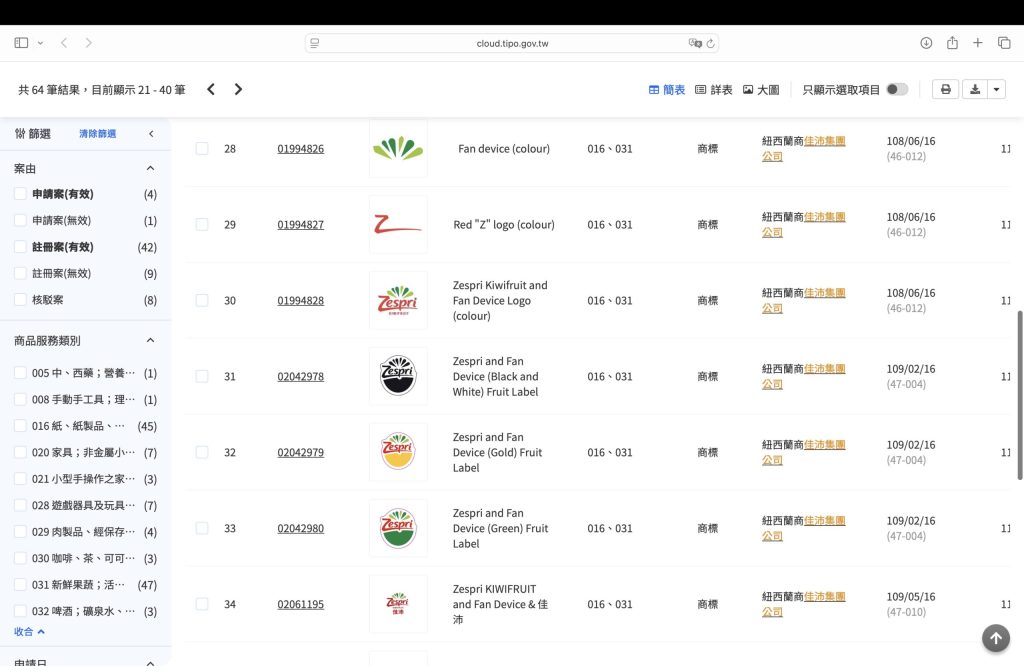
Upon examining their marketing terminology—such as “SUNGOLD,” “ZESPRI GOLD,” “ZESPRI GREEN,” “ZESPRI RED,” “ZESPRI RUBYRED,” and “ZESPRI 寶石紅” (Ruby Red)—one can observe that these do not actually correspond to official variety names, but rather are market names designed based on the characteristics of the fruit. The actual variety names of these kiwifruits are coded designations such as “Zesy002,” “Zesh004,” and “ZES006.”

Zespri Group Limited’s strategy appears to be as follows: use coded designations as official variety names, while creating popular market names based on the characteristics of different varieties, and vigorously promote these names to make them well-known to consumers. For consumers, they typically become familiar with names such as “SUNGOLD” or “ZESPRI,” rather than complex and difficult-to-remember variety names. These market names are simultaneously registered trademarks, forming trademark protection. Even if others sell the same or similar varieties, they may not use the names most familiar to consumers, such as “SUNGOLD” or “ZESPRI.” This approach, combining trademark protection with marketing, constitutes an extremely intelligent protection strategy.
Zespri Group Limited’s success in the global kiwifruit market depends not only on breeding technology and variety selection, but also on its skillful utilization on trademark rights alongside its variety rights, making it the leading kiwifruit brand. Although the company has faced challenges in recent years, such as variety leakage—for example, the emergence of counterfeit kiwifruit orchards in China that have damaged its legitimate interests—it is undeniable that Zespri Group Limited has established an exemplary model for variety protection and brand management worthy of emulation.